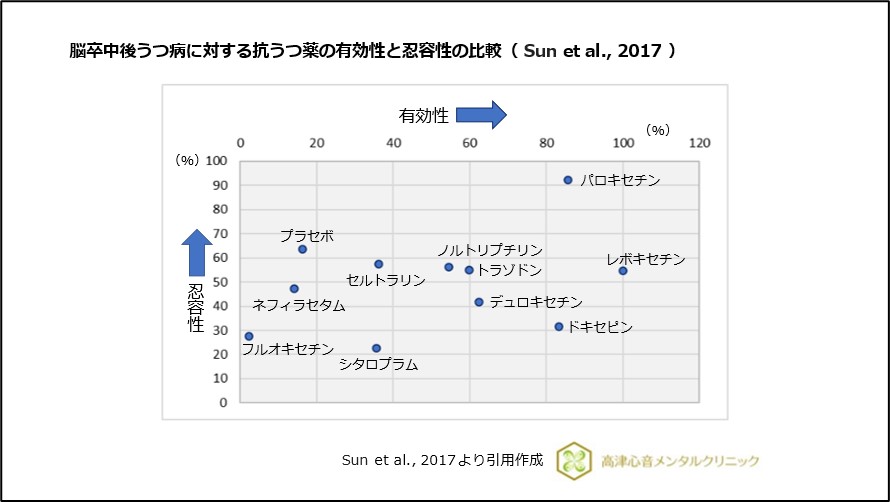
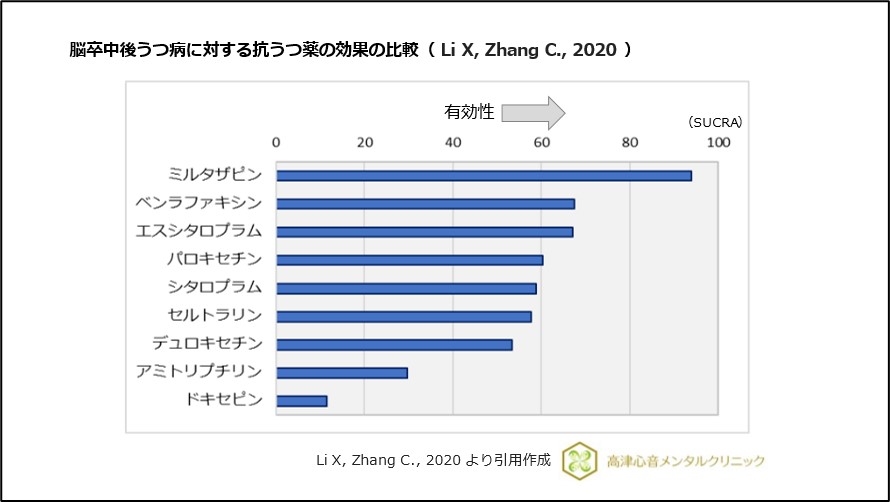
Li XとZhang Cは2020年に上記3件の解析に含まれていなかった、ミルタザピン(リフレックス・レメロン)、エスシタロプラム(レクサプロ)、アミトリプチリン(トリプタノール)を新たに比較に組み込んだ、研究対象者数5,547人、試験数51件を含む、脳卒中後うつ病に対する抗うつ薬の有効性の比較を行いました。
1)Guo J, et al. : The advances of post-stroke depression: 2021 update. J Neurol, 269 : 1236-1249, 2022.
2)Villa RF, et al. : Post-stroke depression: Mechanisms and pharmacological treatment. Pharmacol Ther, 184 : 131-144, 2018.
3)Sun Y, et al. : Comparative efficacy and acceptability of antidepressant treatment in poststroke depression: a multiple-treatments meta-analysis. BMJ Open, 7 : e016499, 2017.
4)Deng L, et al. : Efficacy and tolerability of pharmacotherapy for post-stroke depression: a network meta-analysis. Oncotarget, 9 : 23718-23728, 2018.
5)Qin B, et al. : Efficacy, acceptability, and tolerability of antidepressant treatments for patients with post-stroke depression: a network meta-analysis. Braz J Med Biol Res, 51 : e7218, 2018.
6)Li X, Zhang C. : Comparative efficacy of nine antidepressants in treating Chinese patients with post-stroke depression: A network meta-analysis. J Affect Disord, 266 : 540-548, 2020.
7)Zhang H, et al. : Therapeutic effect of Chinese herbal medicines for post-stroke depression: A meta-analysis of randomized controlled trials. Medicine (Baltimore), 100 : e24173, 2021.
8)Kwon CY, et al. : Efficacy and safety of Sihogayonggolmoryeo-tang (Saikokaryukotsuboreito, Chai-Hu-Jia-Long-Gu-Mu-Li-Tang) for post-stroke depression: A systematic review and meta-analysis. Sci Rep, 9 : 14536, 2019.
9)Zhou L, et al. : The etiology of poststroke-depression: a hypothesis involving HPA axis. Biomed Pharmacother, 151 : 113146, 2022.